
Starlink India Delay: What Musk Said About Ambani, What the Government Replied, and What's Still Pending
This is a developing story. It was last updated on the morning of October 16, 2026, after Reliance Industries issued its first formal statement, and we will update it as things change. Where outlets disagree, we say so. We attribute every claim to whoever made it and do not take a side.
Starlink has been trying to launch in India for years and still cannot sell service. Between October 7 and 9, 2026, Elon Musk publicly blamed unnamed “oligarchs”, asked “Is Ambani the real boss of India?”, and then addressed a post directly to “Prime Minister Ambani”. The government rejected the suggestion, the Leader of the Opposition joined in, and on October 16 Reliance Industries issued its first formal reply. Here is what each party actually said, and what the approval process looks like.
What happened, in order
Wednesday, October 7. At the India Mobile Congress, Starlink’s Lauren Dreyer said the company has built 20 gateway sites in India with hundreds of antennas, that Indian user data will stay in India, and that Starlink is ready once the government is. She said she hopes Starlink will be authorised by the next congress.
At 8:53 pm IST the same day, Musk posted on X, quoting a post by @cb_doge about rural connectivity in India: “Unfortunately, we are being blocked by certain oligarchs in order to maintain their monopolistic chokehold on the Indian people. You can guess who they are … This is a crime against the people of India!” He named no one in the post and offered no evidence.
Unfortunately, we are being blocked by certain oligarchs in order to maintain their monopolistic chokehold on the Indian people. You can guess who they are …
— Elon Musk (@elonmusk) October 7, 2026
This is a crime against the people of India!
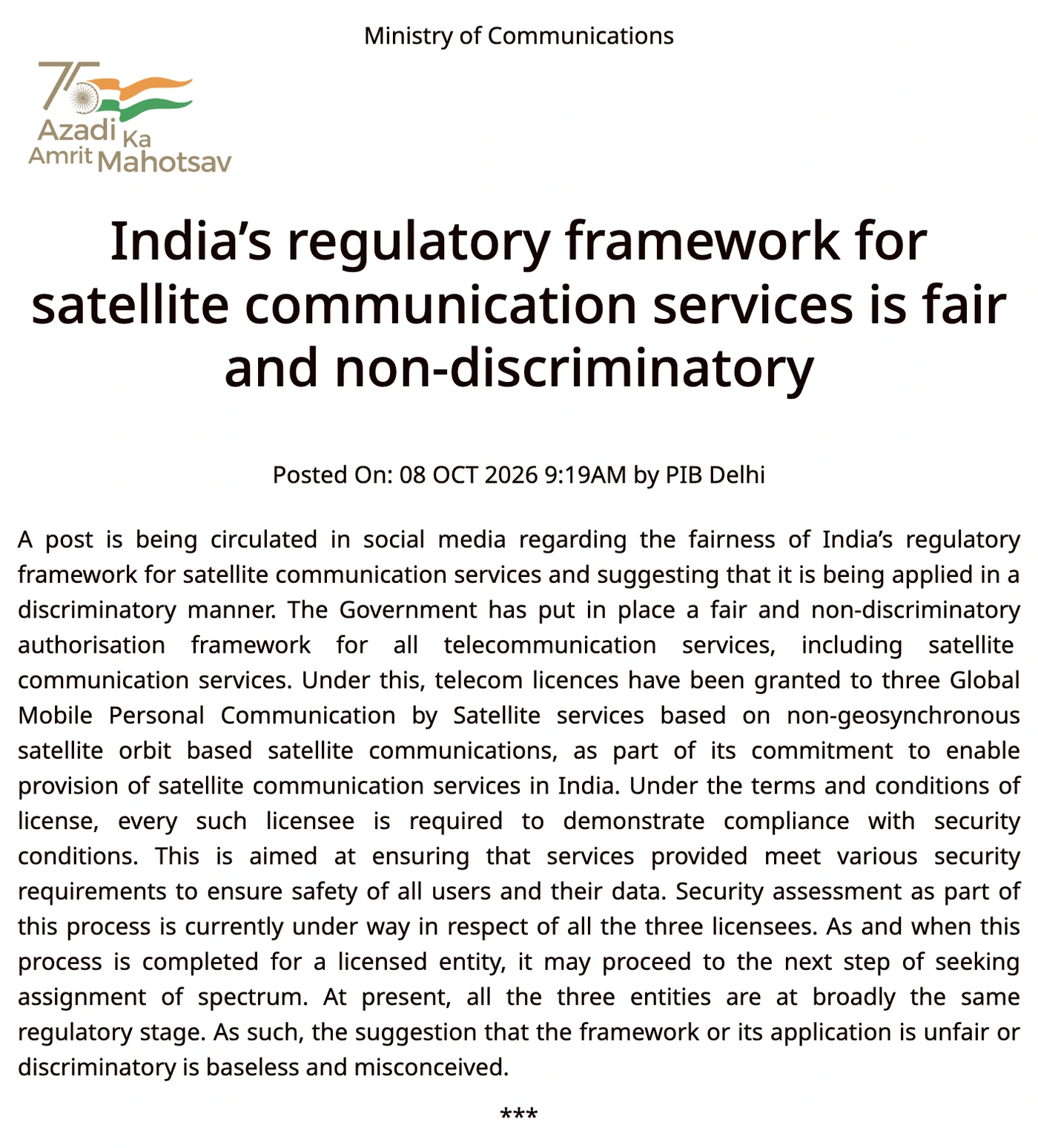
Thursday, October 8, morning. At 9:19 am IST, the Ministry of Communications published a press release through the Press Information Bureau titled “India’s regulatory framework for satellite communication services is fair and non-discriminatory”. It said “a post is being circulated in social media” suggesting the framework is applied in a discriminatory manner, and did not name Musk or Starlink. It said telecom licences have been granted to three satellite (GMPCS) operators, that every licensee must demonstrate compliance with security conditions, and that the security assessment is “currently under way in respect of all the three licensees”. Once that is complete, a licensee “may proceed to the next step of seeking assignment of spectrum”. It said “at present, all the three entities are at broadly the same regulatory stage” and that the suggestion that the framework or its application is unfair or discriminatory is “baseless and misconceived”. Minister of State Chandra Sekhar Pemmasani said the pending clearance is with the Home Ministry and is “not specific to any one company”.
Thursday, October 8, evening. At 6:55 pm IST, Musk posted: “Starlink is licensed in over 165 countries and has spent five years complying with every single law and requirement of the government of India, so why still no license? Is Ambani the real boss of India?” The post quoted another user’s post, by Dr Aniruddha Malpani (@malpani), which said: “The government is more interested in protecting the interests of crony capitalists than of citizens”. Musk did not say which Ambani he meant, though Mukesh Ambani chairs Reliance Industries, which owns Jio.
Starlink is licensed in over 165 countries and has spent five years complying with every single law and requirement of the government of India, so why still no license?
— Elon Musk (@elonmusk) October 8, 2026
Is Ambani the real boss of India?
Rahul Gandhi. The Congress leader replied to Musk on X: “Welcome to India, Elon. Wait till you discover the other guy.” He did not name anyone. The remark may be a reference to Gautam Adani, though Gandhi did not say so. We found no public response from the Adani group or the BJP at the time of writing. Musk replied: “Thank you, Rahul. This is indeed troubling.”
Reliance and Jio, October 8. Reliance did not respond to the posts at the time; its formal statement came on October 16, and is below. Akash Ambani, speaking about Jio at the congress, said the company wants to stay “heads down” and deliver value to Indian consumers, and that Jio is making progress on its own satellite broadband stack (Business Today). Reports differ on whether he declined to comment on Musk’s remarks or said he had not seen them. Sunil Mittal said Airtel-backed OneWeb is “waiting too” (Scroll).
Friday, October 9. At 10:33 pm IST, Musk posted a message that opened “Dear Prime Minister Ambani,” and went on: “Please accept my humble apologies for not realizing that you are the real boss of India.” It continued: “Naturally, you would prefer to maintain your monopolistic exploitation of the great people of India, but would you nonetheless consider allowing Starlink to compete?” He then wrote that there are “many areas of India, as there are in all countries, with no Internet access, which denies children the opportunity for education and for small businesses the opportunity to sell their goods to a global market”, and that “Starlink would change their lives for the better.” The post sets out no evidence for the accusation. Reliance’s formal reply came a week later, on October 16, and is covered below.
Dear Prime Minister Ambani,
— Elon Musk (@elonmusk) October 9, 2026
Please accept my humble apologies for not realizing that you are the real boss of India.
Naturally, you would prefer to maintain your monopolistic exploitation of the great people of India, but would you nonetheless consider allowing Starlink to compete?
There are many areas of India, as there are in all countries, with no Internet access, which denies children the opportunity for education and for small businesses the opportunity to sell their goods to a global market. Starlink would change their lives for the better.
Thank you 🙏
Friday, October 9: the minister. Communications Minister Jyotiraditya Scindia said at a media briefing that “India does not allow a monopoly in any sector”, and that three companies hold satellite licences: Starlink, Jio’s satellite arm and OneWeb. He said none of them has received security clearance yet, that each can begin only after it meets the security conditions individually, and that spectrum will be assigned once the government sets a revenue-based charge, which he said TRAI and the Department of Telecommunications were close to finalising. He described the government as “technology agnostic”. Scindia also accused the Congress party of changing its stance on the issue and of aligning with Musk. He did not, in the reporting we found, address the Ambani question directly.
Saturday, October 10 to Sunday, October 11: pricing and political donations. News reports dated October 10 say Musk shared screenshots of earlier media reports about a Reliance-linked company’s political donations and about a Reliance-funded firm’s role in boosting BJP campaigns on Facebook. We have not verified those underlying reports, and found no response to them from Reliance or the BJP. Reports dated October 10 and 11 (outlets differ on the day, probably because of time zones) quote Musk posting that “the ridiculous arguments by Ambani’s internet supporters make no sense”, calling them “absurd hypocrisy and hyperbole”, and writing that “if Starlink is too expensive in India, no one will buy it, so SpaceX will need to make pricing affordable” and that “Ambani’s profits will be lower, but he is not going out of business.” He gave no India price. We could not view these posts directly at the time of writing, so we quote only the wording the reports agree on. Mobile data in India costs roughly 8 US cents a gigabyte, according to the same reports.
Wednesday, October 14 to Thursday, October 15: a side row about Ukraine. Not about India, but it landed in the middle of this story and bears on it. At 11:36 pm IST on October 14, Ukraine’s Mykhailo Fedorov posted that Starlink connectivity “at speeds of up to 160 km/h is being restored” and that removing Starshield’s speed limit “entirely is now critical for Ukraine’s defense”. Starshield is SpaceX’s government and military service; Starlink is the civilian one. Reports say Ukrainian officials suggested the slowdown on some terminals came from Washington, and that the military did not get advance warning. At 12:30 am IST on October 15, Musk replied that “Starshield systems are owned and controlled by the US government”, that “any limits on speed or usage are decided by the US military and ultimately POTUS”, and that Starlink is “a commercial service owned and controlled by SpaceX” whose use is “limited to civilian or defensive activities”. We found no Pentagon, White House or SpaceX statement beyond Musk’s post, and we cannot independently tell who set any limit.
Starlink connectivity at speeds of up to 160 km/h is being restored.
— Mykhailo Fedorov (@FedorovMykhailo) October 14, 2026
Removing Starshield’s speed limit entirely is now critical for Ukraine’s defense.
Thank you, @elonmusk. We hope for your continued support.
@FedorovMykhailo Starshield systems are owned and controlled by the US government. Any limits on speed or usage are decided by the US military and ultimately POTUS.
— Elon Musk (@elonmusk) October 15, 2026
Starlink is a commercial service owned and controlled by SpaceX. Usage of Starlink is limited to civilian or defensive activities and cannot be used for offensive military action, as doing so would be inappropriate for a commercial company.
Why this matters for India: the argument over who can slow, restrict or switch off a satellite network is the one India’s security conditions are built around. Musk’s reply puts the Starshield limits on the US government and says Starlink is controlled by SpaceX, while Ukrainian officials reportedly also pointed at Washington. The episode shows that limits can be applied to terminals remotely, as with the February 2026 Ukraine whitelist, and that outsiders cannot easily see who decided. None of these accounts is independently checkable from public information.
Friday, October 16: Reliance replies. Reliance Industries issued a statement on its official X account, @RIL_Updates, its first formal response to Musk. It said “in light of recent remarks about Reliance and the Indian market, we wish to place the facts on record”. The main points, in its words:
- India’s openness “rests on the rule of law”, and the government “applies the same process to every applicant, Indian or foreign. Jio’s own satellite services await clearances.”
- “We have never feared competition. We see it as the truest test of who serves the customer best.”
- Jio “entered India’s crowded telecom market in 2016 as the newest player, with not a single customer”, and now has “over 530 million customers”.
- “We welcome competition in satellite communications, including Starlink. Every player, Jio included, must serve the people of India and abide by the laws and policies of the land.”
In the text we saw, the statement does not name Musk or Ambani, and does not address his specific accusations. Reports say it came days before Jio Platforms’ IPO, which they put at October 21 to 23; we have no evidence either way about whether timing played a role in either side’s posts.
Does Starlink have a licence or not?
Both statements are partly right, which is why this is confusing. Starlink holds some Indian authorisations but not the ones needed to start commercial service.
| Approval | Status |
|---|---|
| GMPCS licence (DoT) | Granted June 2025. Allows market preparation, not sales |
| IN-SPACe authorisation | Granted July 8, 2025 for the first-generation constellation of 4,408 satellites. A second-generation application is pending after an earlier one was rejected |
| Spectrum | Not yet assigned. The Digital Communications Commission backed a charge of 5% of adjusted gross revenue (4% for rural and remote service) on Sep 3; it still needs the inter-ministerial panel and the Cabinet |
| FDI approval | Needed by Starlink; OneWeb and Jio Satellite reportedly do not need it |
| Final security clearance | Pending with the Home Ministry, per the minister |
The ministry says three operators hold licences and are in security assessment before they can seek spectrum. Its release did not name them; they are Starlink, Jio’s satellite arm and OneWeb. Starlink says it has complied with everything asked of it. Both can be true at once, because licensing and final clearance are separate steps.
The security question
The government has not published what its assessment covers, so the specifics here come from reporting. In June 2026, Bloomberg reported that security agencies under the Home Ministry had withheld final clearance after SpaceX allowed Starlink access inside Iran without a licence to operate there, according to coverage by MediaNama. Starlink’s Dreyer called such stories “misleading” and based on “unsubstantiated claims from anonymous sources”, and said the company remains in “active and productive discussions” with the government. We found no official Indian statement confirming or denying the report.
Separately, Indian forces have reported finding Starlink equipment in a drug seizure in the Andaman and Nicobar Islands and in an army operation in Manipur since 2024. Musk has said Starlink beams are “turned off over India” and that claims of use by militants are “absolutely false”. He first said this in December 2024, and repeated it on October 8. Other reporting, including from the Guardian as cited by Deccan Herald, quoted a security source saying Starlink may work in some Manipur areas close to the Myanmar border. A recovered terminal does not by itself show it connected to the network. This remains unresolved.
For how Starlink’s network is built and why gateways, laser links and geofencing matter to India’s rules, see our technical guide: How Starlink Works.
Where Ambani and Jio come in
The background is a 2024 dispute over how satellite spectrum should be allocated. Reliance argued that an auction was needed for a level playing field (Tribune). In October 2024 the government chose administrative allocation instead, and Musk wrote on X that he “much appreciated” the decision.
Then the relationship changed. In March 2025, both Jio and Airtel signed deals to distribute Starlink in India, on condition that SpaceX received its own authorisations. Al Jazeera describes the cooperation as having “appeared to have soured”. We found no public announcement that the Jio-SpaceX partnership has ended. Reliance’s own satellite venture holds one of the three licences and would compete with Starlink if it launches.
Nothing in the reporting we reviewed shows evidence that any company is blocking Starlink. Musk has asserted it, most directly in his October 9 post accusing Ambani of “monopolistic exploitation”, and the government has denied that its framework is unfair or discriminatory. We have no way to confirm either position from public documents.
What we know and don’t know
Known:
- The posts and replies above were made, on the dates reported.
- Starlink is not yet selling service in India and has no launch date.
- Spectrum pricing still needs Cabinet approval, and security clearance and FDI approval are pending.
- The government says all three licensees are in the same process, and Scindia said none has yet received security clearance.
- Reliance has now said, in its own statement, that it welcomes competition including Starlink and that Jio’s satellite services also await clearances.
Not known:
- What the security assessment covers, or what would resolve it.
- Whether the Bloomberg report about Iran accurately reflects the Home Ministry’s reasoning. Starlink disputes it and the government has not commented.
- Who Musk meant by “oligarchs” on October 7. He did not name anyone in that post, and named Ambani in his posts of October 8 and 9.
- Whether anything Musk has alleged about Reliance or political donations is true. We have verified none of it, and no reply from the BJP has been reported.
- Who set the Starshield limits in Ukraine. Musk says the US government did; we found no US or Pentagon statement confirming or denying it.
- How long approvals will take.
What readers should not rely on
Starlink has not announced official Indian pricing. Starlink clarified that a monthly price of ₹8,600 that briefly appeared on its India website in December 2025 was dummy test data from a website glitch. Figures like ₹2,500 to ₹3,500 a month circulating in the press are reports, not company numbers. Starlink has said it is not taking orders in India, and the service is not yet available. Be wary of anyone selling a “Starlink India pre-booking”, and check Starlink’s official channels.
What happens next
Scindia has said TRAI and the Department of Telecommunications are close to a final decision on the pricing regime. The next formal steps are Cabinet approval of the spectrum charge, the Home Ministry’s security clearance, and FDI approval for Starlink. Dreyer said she hopes for authorisation by next year’s India Mobile Congress, per reports. We will update this post when any of these moves.